
Biography
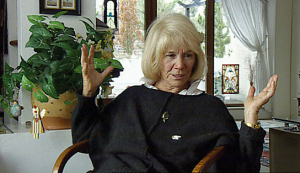
Beate Mainka-Jellinghaus was born on July 27, 1936, in Vogtsdorf, then part of Germany and now in Poland. Toward the end of World War II, she fled with her parents and siblings to Ansbach in Bavaria, where the family settled in 1945. There, her mother enrolled her in ballet school, where she trained for six years. Inspired by her love of dance, Mainka-Jellinghaus dreamed of becoming a choreographer, but her father discouraged the idea, dismissing it as "a profession for ten or twenty years."
Instead, she completed an apprenticeship at a film laboratory in Wiesbaden between 1953 and 1955. During this time, pioneering filmmaker Harry Piel unexpectedly invited her to work as an assistant editor on his adventure film "Gesprengte Gitter – die Elefanten sind los" (1953), giving her first experience on a feature film.
She later became second assistant editor to Anna Höllering at Bavaria Film Studios in Munich. Between 1955 and 1958, she worked on four feature films directed by Rolf Hansen. Soon afterward, she took on her first project as lead editor with the television film "Ein gewisser Judas" (1958), the only film ever directed by acclaimed Austrian actor Oskar Werner.
From 1958 to 1960, Mainka-Jellinghaus began working with filmmaker Edgar Reitz. Largely for financial reasons, the two produced industrial and advertising films together, but they also made several experimental short documentaries, including "Yucatan" (1960).
Through Reitz, who had helped establish the Institute of Film Design at the Ulm School of Design, Mainka-Jellinghaus met filmmaker Alexander Kluge in 1965. While assisting students with editing their film projects, she caught Kluge's attention. "You have to edit my film," he reportedly told her. She accepted, and the result was "Abschied von Gestern" ("Yesterday Girl," 1966), the groundbreaking film that launched her career as one of Germany's leading film editors.
The success of "Abschied von Gestern" also brought her to the attention of Werner Herzog. As Mainka-Jellinghaus later recalled, Herzog came to her home and insisted, "There's no one else - you have to do it." She went on to edit his debut feature, "Lebenszeichen" ("Signs of Life," 1968), beginning a long and highly influential creative partnership.
Alexander Kluge and Werner Herzog remained the two central collaborators of Mainka-Jellinghaus's career. Although she occasionally worked with other directors, nearly all of the more than fifty feature-length and short fiction and documentary films she edited through the mid-1980s were created by filmmakers associated with the New German Cinema movement.
Among the most significant projects of her career was "Deutschland im Herbst" ("Germany in Autumn," 1978), the landmark collaborative film made by many of the movement's leading directors. Film critic Bion Steinborn described Mainka-Jellinghaus as the production's "control center," crediting her editorial skills and organizational vision with making the ambitious collective project possible. In addition to editing, she also received a screenwriting credit on "Deutschland im Herbst" and on Alexander Kluge's "Vermischte Nachrichten" ("Miscellaneous News," 1986).
By 1986, Mainka-Jellinghaus had edited eighteen films for Kluge and twenty for Herzog, including celebrated works such as “Fitzcarraldo” (1982) and “Krieg und Frieden” (“War and Peace,” 1983). She received the German Film Award (Film Band in Gold) twice: first in 1975 for her editing of Kluge's "In Gefahr und größter Not bringt der Mittelweg den Tod" ("In Danger and Deep Distress, the Middleway Spells Certain Death") and "Jeder für sich und Gott gegen alle" ("The Enigma of Kaspar Hauser," both 1974), and again in 1978 as part of the creative team behind "Deutschland im Herbst."
The intensity of her work with Kluge and Herzog eventually took its toll. As she later explained, editing demanded such complete emotional and mental commitment that little room remained for a private life. She also felt she had explored everything the craft could offer: "You reach a point where you say: now you can do everything, now you know everything – it starts repeating itself. And then you simply don't want to continue."
In 1988, she worked one final time as editor on the television documentary "Geb. 1899, Alfred Sohn-Rethel, Sozialphilosoph", directed by Günther Hörmann. The industry's transition from physical film editing to video editing also contributed to her decision to retire, as she felt the new technology no longer allowed the same careful attention to each individual frame that had defined her approach.
In the documentary "Schnitte in Raum und Zeit" (2006), directed by Gabriele Voss, Mainka-Jellinghaus reflected on her career alongside several other distinguished film editors. She lives in Munich.
Author: Jan-Henrik Branding
This text was written as part of the master's program "Film Culture: Archiving, Programming, and Presentation," jointly offered by Goethe University Frankfurt and the German Film Institute (DFF).