
Gallery
All Pictures (14)Biography
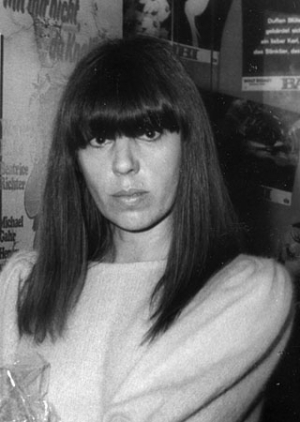
May Spils (born Maria-Elisabeth Maier-Spils on July 29, 1941, in Twistingen, Lower Saxony) showed a strong artistic streak from an early age. After graduating from high school, she attended the Berlitz language school, worked briefly in Hamburg as a foreign correspondent for an advertising agency, and later studied acting in Bremen. She founded a small experimental theater company, but it closed after two unsuccessful productions. She then spent a short time in Paris, where she wrote a novel, a play, and several short stories, none of which she ever chose to publish.
In 1962, Spils moved to Munich's Schwabing district, then the heart of the city's vibrant artistic and countercultural scene. She worked in a variety of fields, including as a fashion model and actress in small film roles, and soon met future collaborators Henry van Lyck, filmmaker Klaus Lemke, director Peter Schamoni, and actor-writer Werner Enke. Together with Enke, she began making short films in 1963. One of them, "Das Portrait" ("The Portrait," 1965), which she wrote, directed, produced, and starred in, won an award at the Mannheim Film Festival.
Spils became part of the "New Munich Group," whose films captured the distinctive spirit of 1960s Schwabing. This laid-back, anti-establishment attitude – often described as valuing refusal over activism and playfulness over anger – became the hallmark of her work. Rejecting middle-class conventions, the films celebrated idleness, flirtation, and an irreverent approach to life.
Werner Enke, who would become the defining star of Spils' films, embodied this worldview so naturally that he and Henry van Lyck inspired the central characters in her first feature. Spils later described how the screenplay for "Zur Sache, Schätzchen" ("Go for It, Baby," 1968) came about:
"I became friends with these two guys and spent more and more time with them—it was simply fun watching them. Gradually I became convinced that these two young men, with their rather peculiar attitude toward what people generally call life, were made for the movies. … They both always seemed to live just a little outside reality."
"Zur Sache, Schätzchen" turned Enke into an icon of cool, carefree nonconformity. His quick wit and effortless charm perfectly expressed Spils' vision of a generation that refused to fit into society's expectations.
In 1968, Spils and Enke received the German Film Award (Film Band in Gold) for the film's dialogue. Two years later, they were honored with the Ernst Lubitsch Award for their second feature, "Nicht fummeln, Liebling" ("Don't Fumble, Darling," 1970). Although Spils' films often playfully hinted at sex and romance, they were never sexploitation films. Rather than relying on explicit content, they used flirtation and innuendo to poke fun at the conservative values of postwar West Germany. As film scholar Christian Albrecht Gollub has observed, beneath their entertaining surface, the films offered a subtle critique of the social conformity of the era.
Spils' feature films quickly made her one of Germany's best-known directors. She became the first woman associated with the New German Cinema to achieve major commercial success, and her work also attracted attention internationally. After 1970, she directed three more features, including "Hau drauf, Kleiner" (1974) and "Wehe, wenn Schwarzenbeck kommt" (1978). Improvisation remained central to her filmmaking throughout her career. She often dispensed with fixed dialogue, allowing Werner Enke and his co-stars to shape scenes freely as they performed. Her trademark blend of anti-establishment humor and slapstick carried through to her final feature, "Mit mir nicht, du Knallkopp" ("Not with Me, You Idiot," 1983), after which she retired from filmmaking.
In the early 1990s, Spils and Werner Enke – her longtime creative partner and companion – left Munich's Schwabing district, feeling that the once-bohemian neighborhood had become too conventional and conservative.
Author: Miriam Sterna
This text was written as part of the master's program "Film Culture: Archiving, Programming, and Presentation," jointly offered by Goethe University Frankfurt and the German Film Institute (DFF).