
Gallery
All Pictures (2)Biography
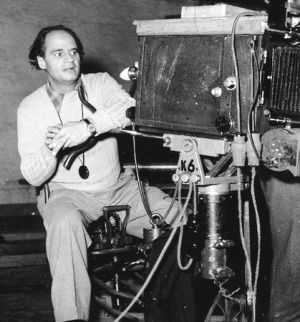
Richard Angst was born July 23, 1905, in Zurich. The son of a Swiss father and a German mother grew up in Pforzheim, where he attended secondary school and business school. In 1923, the nature-loving skier, ski jumper and mountaineer was discovered by Sepp Allgeier, the senior director of a school for cinematography in Freiburg. He started working as an assistant to Arnold Fanck who held a PhD in geology and directed ski films and mountain films. At the "Berg- und Sportfilm GmbH" company, Angst became familiar with camera technique and film laboratory work. He also became a licensed projectionist.
In 1926, he joined Bernhard Villinger's film expedition to Spitsbergen. Alongside Allgeier and Albert Benitz, Richard Angst earned his first credit as cinematographer with the movie "Milak, der Grönlandjäger". Himself, his teacher Allgeier as well as Hans Schneeberger quickly rose up in ranks and became Fanck's chief camera operators. Their credits include movies such as "Der große Sprung" ("The Great Leap"), "Die weiße Hölle von Piz Palü" ("White Hell of Pitz Palu"), "Stürme über dem Montblanc" ("Avalanche"), and "Der weiße Rausch" ("Ski Chase"). Angst's talents as cameraman and mountaineer were also sought-after by other directors.
In 1932, Angst joined Fanck on a trip to Greenland, where he worked on the two versions of "S.O.S. Iceberg" as well as Andrew Marton's "North Pole, Ahoy!". For the time being, "Der ewige Traum" ("The Eternal Dream") became the last European mountain movie production on which Angst collaborated with Fanck.
During the following years, his profession as a cinematographer brought him to different places in Asia: In 1934/35, he worked with G. O. Dyhrenfurth in the Himalayas, and in 1936 he joined Victor von Plessen on an expedition to Borneo, where he came down with a serious illness. In the same year, Angst and Fanck shot the feature film "Die Tochter des Samurai" ("Atarashiki tsuchi") in Japan. On their journey through Japan and Manchuria, they produced documentary material, which was published as a series of short films by the UFA's Cultural Film Department during the 1940s.
After finishing work on Richard Schweizer's "Kleine Scheidegg", which was shot in Angst's home country, he travelled back to Japan to shoot the Olympics movie "Das heilige Ziel" ("Kokumin no chikai"). On behalf of the Japanese Naval Department, he shot a (lost) film about the battle against Chinese guerillas at the Wanpoo River.
In 1939, Angst returned to Berlin to shoot studio movies on behalf of the production company Tobis. Furthermore, he repeatedly worked for Terra and collaborated with the director Hans Steinhoff. Their movies include "Die Geierwally" ("Wally of the Vultures") and "Rembrandt", which became famous for its topic-related use of light and shade.
Bombed out in Berlin at the end of World War II, Angst went to the Austrian Oetz Valley, where he collaborated with Leopold Hainisch on the Tyrol sentimental films "Ulli und Marei" and "Erde". Together with his wife and their five children, he took up residence in Ticino. At the Matterhorn, he photographed the movie "High Conquest", directed by the American Irving Allen. Later, the director used the footage for a short film called "Climbing the Matterhorn", which was awarded the Oscar as "Best Short Film" in 1947.
In the Netherlands, Angst photographed Jaap Speyer's "Een koninkrijk voor een huis", before shooting his first German post-war movie in 1950: "Föhn" ("The White Hell of Pitz Palu"), a remake of Fanck's "Die weiße Hölle von Piz Palü" ("The White Hell of Pitz Palu"), starring Hans Albers. Subsequently, he worked for the German film industry on a regular basis. He photographed four of Harald Braun's distinguished melodramas as well as some of Kurt Hoffmann's entertainment films (twelve movies between 1951 and 1967), including "Ich denke oft an Piroschka" ("I Often Think of Piroschka"), "Das Wirtshaus im Spessart" ("The Spessart Inn"), "Wir Wunderkinder" ("Aren't We Wonderful?"), "Schloss Gripsholm" ("The Gripsholm Castle"), and "Rheinsberg". During the 1960s, he repeatedly worked on movies directed by Franz Josef Gottlieb.
Angst, by now known as the Grand Old Man of German cinematography while also being dreaded by directors and assistants for his impulsive and often rude behavior, was engaged by Artur Brauner for the prestige productions "The Tiger of Eschnapur" and "Das indische Grabmal" ("The Indian Tomb"), directed by Fritz Lang. Furthermore, he collaborated with Robert Siodmak on the two-parter "Kampf um Rom" ("The Fight For Rome").
At the end of the 1960s, Angst resigned due to the upcoming wave of sexploitation films but continued to work on a number of commercials. In 1971, he opened the restaurant "Provinz" in Berlin-Moabit, where he often worked at the bar and in the kitchen.
Assisted by the journalist Hans Bogelt, Richard Angst wrote his memoirs titled "47 Jahre objektiv gesehen". The manuscript was comprised of 700 pages. At the beginning of the 1980s, Jörg Moser-Metius engaged him as an artistic consultant for his short film "Umbra", which was influenced by the style of German silent movies. Furthermore, Moser-Metius produced a television documentary about Angst.
Richard Angst has worked as an assistant professor at the Academy for Television and Film (HFF) in Munich for two years. On July 24, 1984, he died from heart failure at a hospital in Berlin.
His inheritance, including the comprehensive manuscript volume, is filed at the Deutsche Kinemathek - Museum für Film und Fernsehen.